


How to Create a Lower-Tox Cleaning Routine Without Replacing Everything You Own
Do I need to replace all my cleaning products to go lower-tox?
No. A lower-tox cleaning routine doesn't have to begin with replacing your entire cleaning cupboard.
If something you already own works for your household and you're comfortable using it, there isn't much sense in throwing it away simply so you can buy something new.
Start gradually.
Finish what you're using.
Then, as products run out, look at what you'd like to change.
You might start with the multipurpose cleaner you reach for every day.
Then the bathroom cleaner.
Maybe the glass cleaner after that.
There is no rule saying your entire home needs to change by Tuesday.
And there certainly isn't a prize for doing it all at once.
1. Start with the products you actually use
Open your cleaning cupboard and have a look.
Not at what Instagram says you need.
At what you actually use.
Which bottle are you constantly reaching for?
Which products sit untouched at the back?
Do you have three different sprays essentially doing the same job?
Are there products you bought for one very specific purpose and haven't touched since?
Before buying anything new, understanding what your household genuinely uses can make your cleaning routine much simpler.
For many homes, that may mean having a few dependable products rather than a cupboard overflowing with specialised cleaners.
Lower-tox doesn't have to mean more products.
Sometimes it can mean fewer.
2. Use what you already have
Wanting to reduce waste doesn't mean everything currently in your home suddenly belongs in the bin.
Use products you already own where you're comfortable doing so.
Use your existing cleaning cloths.
Keep bottles and tools that still have plenty of life left in them.
Then replace things thoughtfully when they actually need replacing.
There's a difference between buying differently going forward and throwing away perfectly usable things because they don't fit your new ideal.
You don't need the perfect cleaning cupboard.
You need one that works for your home.
3. Change things as they run out
This is probably the easiest place to start.
Instead of creating a huge list of everything you want to replace, wait for the natural prompt:
Something ran out.
That's your moment to decide.
Do I want to buy the same thing again?
Is there a lower-tox option I'd prefer?
Could I refill something instead of replacing the whole product?
Would one product do the job of two things currently sitting in my cupboard?
It turns a potentially overwhelming project into a series of tiny decisions made over time.
And tiny decisions are much easier to live with.
4. If the bottle still works, ask whether you actually need another one
We're very used to buying cleaning products as a complete package.
Cleaner runs out.
Bottle goes in the bin.
Another bottle comes home.
Cleaner runs out.
Repeat.
But the bottle wasn't necessarily the thing that needed replacing.
The cleaner was.
That's one of the reasons refillable cleaning systems make sense to us.
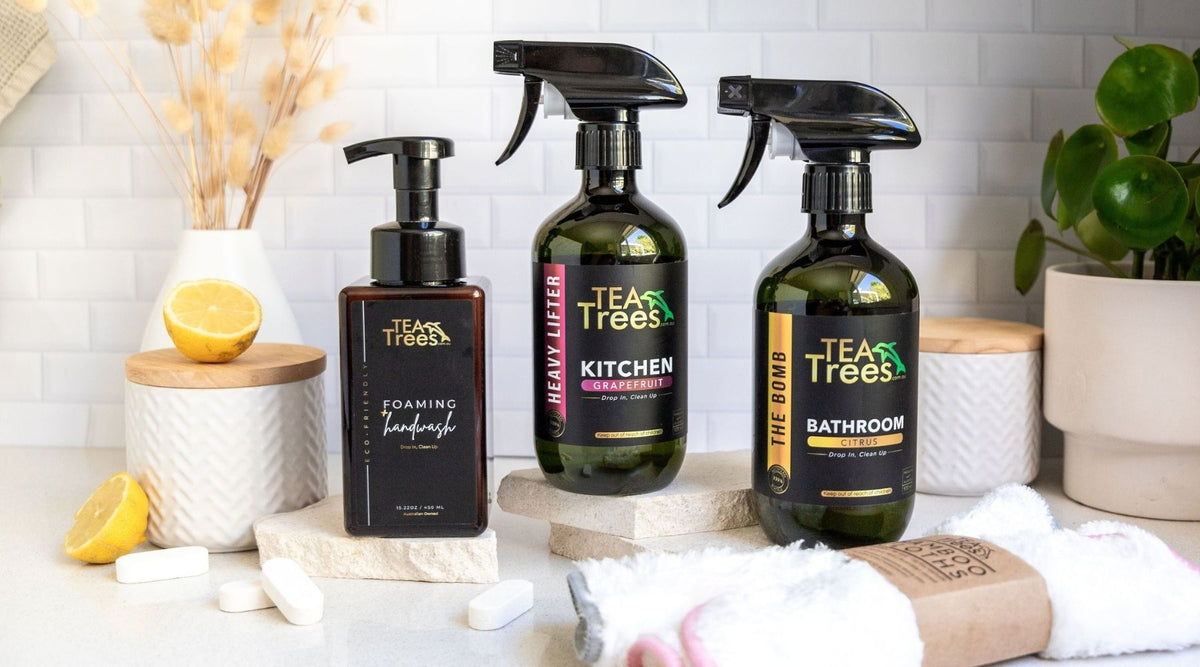
With Tea Trees cleaning tablets, the idea is simple: rather than buying another pre-filled bottle each time you need more cleaner, you can reuse a suitable bottle and make up another refill using a cleaning tablet and water at home.
Fill. Drop. Clean. Refill.
If you're already using a Tea Trees bottle, when your cleaner runs out, you can simply restock the refill tablets rather than starting again with another bottle.
5. Don't make “low-tox” another job on your list
This matters.
Because if your new routine requires 17 steps, a spreadsheet and a Sunday afternoon dedicated to making household cleaning products...
there's a reasonable chance you won't keep doing it.
And that's okay.
The best household routine isn't necessarily the one that looks the most impressive online.
It's the one that works on an ordinary Wednesday when you're tired, dinner needs making and somebody has just spilled something on the floor.
Better choices need to fit into your life.
Not the other way around.
6. Keep the routine simple enough to repeat
When you're considering a new cleaning product or routine, ask yourself:
Will I actually keep doing this?
Does it clean what I need it to clean?
Is it easy to prepare and use?
Do I understand what it's for?
Can I easily restock it?
Does it reduce clutter or create more of it?
Does it fit into the way my household already operates?
Because the goal isn't to create a beautiful collection of “better” products.
The goal is to create a routine you barely need to think about.
7. Forget perfect. Aim for repeatable.
You don't have to transform your entire household to make a worthwhile change.
Maybe this month you stop replacing your multipurpose spray bottle and start refilling it.
Maybe later you do the same with your bathroom cleaner.
Maybe there are other products you decide not to change at all.
That's your home.
You get to decide what makes sense in it.
We'd much rather see someone make one simple change they happily maintain than completely overhaul their cleaning cupboard and hate the process two weeks later.
A simple lower-tox cleaning routine could look like this
1. Use what you already own.
Don't replace things simply for the sake of starting again.
2. Notice what you actually use.
Your routine might need fewer products than you think.
3. Wait until something runs out.
Use that as your cue to reconsider it.
4. Refill where it makes sense.
If the container still works, consider whether you need another one.
5. Choose products that fit real life.
If the routine is too complicated to maintain, simplify it.
6. Repeat.
That's it.
No cleaning-cupboard makeover required.
What are cleaning tablets?
Cleaning tablets are compact concentrates designed to be mixed with water to create a household cleaning solution.
Instead of transporting and purchasing a new bottle of mostly water each time your cleaner runs out, a refill system allows you to add water at home and reuse your bottle.
Tea Trees has different cleaning tablet refills for different household cleaning jobs, so you can restock the cleaner you actually need rather than automatically replacing the bottle too.
EXPLORE TEA TREES CLEANING TABLETS
A cleaner home doesn't have to start with more stuff
If there's one thing we'd love you to take away from this, it's this:
Don't let making a better choice become another standard you have to live up to.
Your home doesn't need to become perfectly low-tox overnight.
Your cleaning cupboard doesn't need to look beautiful.
And you don't need to replace everything you own.
Use what you've got.
When something runs out, make the next decision.
Refill where it makes sense.
Then get on with your day.
Small changes are allowed to be small.
FAQ
What is the easiest way to start a lower-tox cleaning routine?
Start with the products you already use most often. Rather than replacing everything at once, consider alternatives as each product naturally runs out. This makes the change easier to manage and helps avoid replacing usable products unnecessarily.
Do I need different cleaners for every room?
Not necessarily. What you need depends on the surfaces and cleaning jobs in your home. Before buying more products, look at what you currently use and whether some products are rarely needed or overlap in purpose.
Can I reuse my existing cleaning bottles?
It depends on the product and bottle. Always follow the directions for the cleaning product you're using and make sure the container is suitable, clean and correctly labelled. For Tea Trees products, follow the specific preparation and bottle instructions provided with the product.
How do refillable cleaning tablets work?
They are concentrated cleaning tablets that are mixed with the specified amount of water according to the product directions. Once prepared, the cleaning solution can be used as directed without purchasing another pre-filled bottle each time.
Is lower-tox cleaning the same as chemical-free cleaning?
No. Everything is made of chemicals, including water. “Chemical-free” isn't an accurate description of cleaning products. Tea Trees prefers clear, practical language rather than suggesting that something is good or bad simply because it is a chemical.
Comments